
Clark County Scheduled Versus Actual
A date in a sentence record is not always the date a person walks out. A pretrial detainee is held while a case is pending and often has no fixed release date. Bond, a court order, dismissal, time served, or a new hold can change the custody result. A sentenced county-jail detainee may have a commitment and credited days. A state prisoner has fields calculated and maintained by the Idaho Department of Correction.
Clark County Jail does not publish an online roster, date calculator, good-time policy, or weekend-release rule. The direct path is the sheriff at 208-374-5403, paired with the court record when legal authority matters. Ask for the commitment, credited days, any hold, and the release entry. Do not apply IDOC sentence fields to a county-jail stay.
- Pretrial
- Held while the court case remains pending, often without a set exit date.
- Determinate term
- The fixed minimum part of an Idaho unified sentence.
- Indeterminate term
- The later portion during which parole may be considered.
- Detainer
- A request or legal basis for another agency to keep custody after one matter ends.
Find Clark County Release Dates
Begin with the custody type. The IDOC Resident/Client Search is for Idaho correctional records, not every person once held at Clark County Jail. The sheriff and court handle the local side. A federal sentence belongs in the Bureau of Prisons locator, while an immigration hold calls for ICE channels.
- Confirm whether the person is at Clark County Jail, in IDOC custody, in federal custody, or already in the community.
- For Clark County Jail, call 208-374-5403 and ask about the named booking, commitment, credited days, holds, and release entry.
- Use Idaho iCourt or the Clark County court clerk to read the judgment and later orders.
- For an IDOC case, search by Last Name plus First Name or IDOC Number, then open the matching detail record.
- Copy each date label exactly. Confirm the actual release through IDOC or a VINELink Release Check.
The official IDOC search form displays the state's real search fields and its public-data warning.
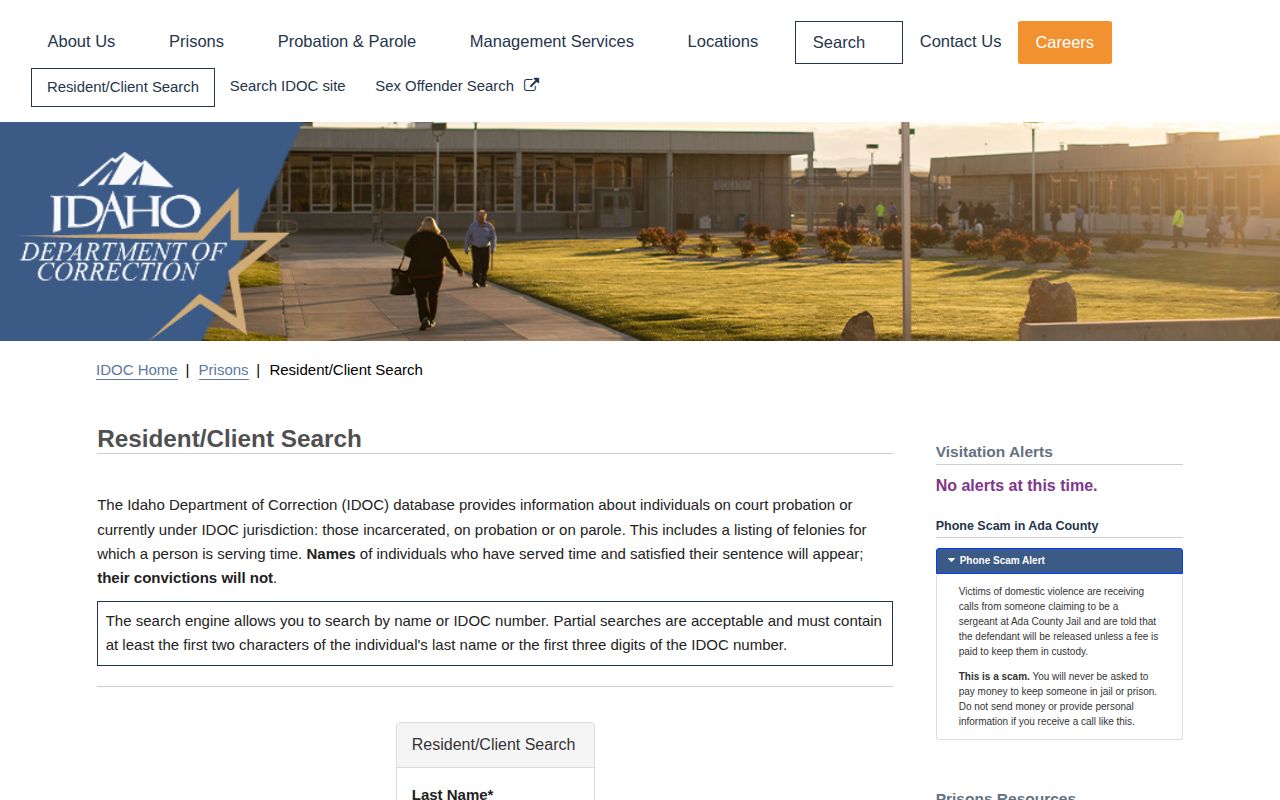
The form requires at least Last Name and First Name together, or an IDOC Number. A middle name and age range can narrow a common-name result.
Idaho Release Date Field Labels
IDOC does not use a generic public field called “Projected Release Date” on the records reviewed. The distinction is critical. Each label answers a different question, and a made-up umbrella label can turn an eligibility date into a false promise.
| Exact Idaho field | What it means |
|---|---|
| Parole Eligibility Date | The point at which the fixed term has generally been served and parole consideration may become possible. |
| Next Parole Hearing Date | A scheduled review event, not a release date. |
| Released to Supervision | The date shown with an In community status for release into supervision. |
| Sentence Satisfaction Date | The sentence-completion date maintained in the record. |
| Discharged [date] | A status showing final sentence discharge on that date. |
The public detail can also show Active offenses, inactive records, Custody status, Location, and Assigned District Office. Data is updated daily and IDOC warns that it is not real time. A person whose result says In community and Released to Supervision has passed a different milestone from someone whose status says Discharged.
An official IDOC detail example illustrates the sentence fields and next-hearing layout. It is an interface example, not a Clark County release.
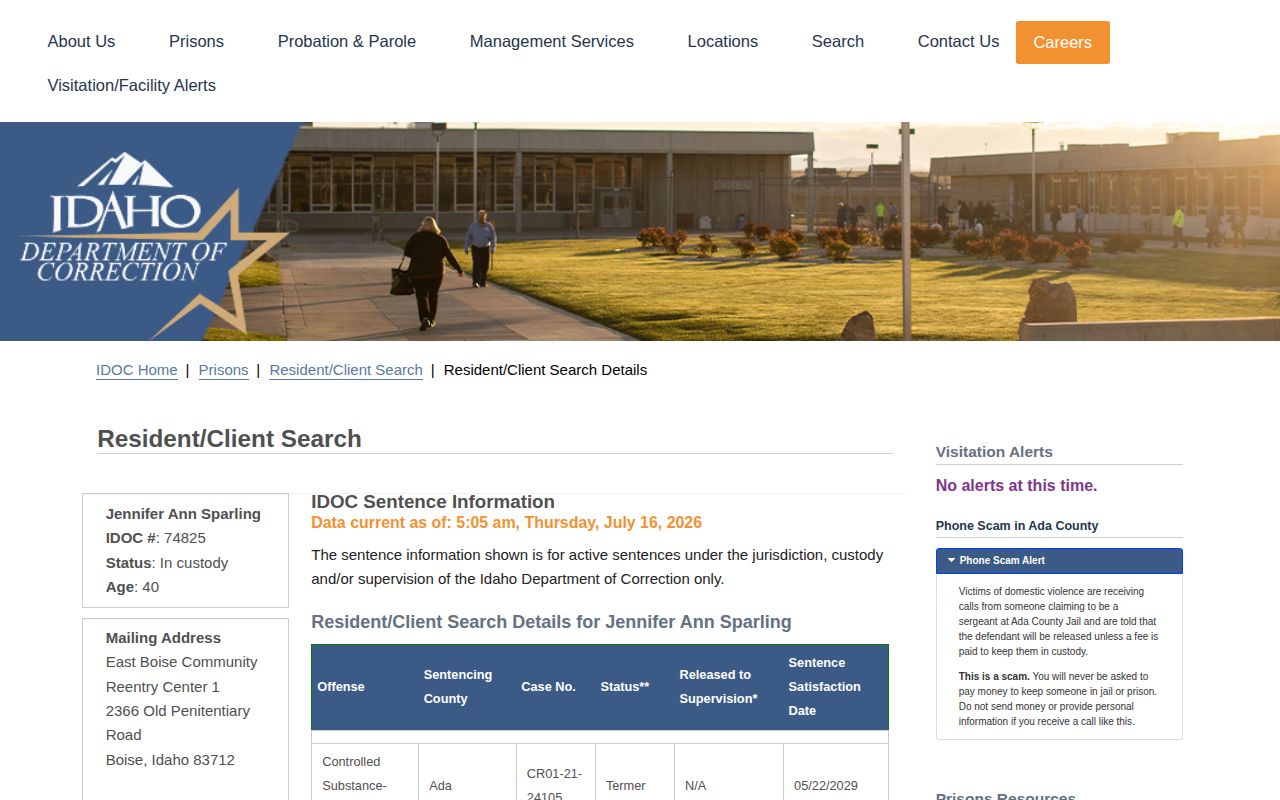
The example shows why the displayed label must be quoted as written instead of being renamed as a projected exit date.
Clark County Fixed-Term Rules
Idaho Code § 19-2513 uses a unified sentence. The sentencing court sets a fixed, or determinate, minimum term followed by an indeterminate portion. Parole eligibility generally begins when the fixed term has been served, subject to lawful sentence calculations and credit. Eligibility opens a discretionary Commission process. It does not order release.
Idaho does not use a generally applicable 85-percent formula for this purpose. Its truth-in-sentencing structure rests on the fixed term set by the court. Generic claims that a modern Idaho prisoner automatically earns “good time” off that fixed term are wrong. Idaho Code § 20-101A applies statutory good-conduct deductions to offenses committed before July 1, 1986.
For multiple sentences, consecutive and concurrent structure matters. Consecutive terms run one after another. Concurrent terms run at the same time. The Commission explains that the latest applicable start of the indeterminate portion can control eligibility. The judgment, jail-credit calculation, and current IDOC data must be read together.
Note: Idaho parole eligibility marks when review may occur; it is not a universal promise of release on that day.
Why Clark Release Dates Change
IDOC Sentencing Records reviews judgments, calculates sentences, applies jail credit and retained-jurisdiction credit, processes parole-forfeiture actions, and maintains sentence data. IDOC cannot rewrite a court sentence. A suspected court error returns to the court. A calculation question belongs with IDOC records.
| Factor | Possible effect |
|---|---|
| Corrected jail credit | Changes credited time used in sentence calculations. |
| Amended judgment | Changes the controlling court instruction. |
| Consecutive or concurrent terms | Changes how multiple sentences combine. |
| Parole forfeiture | Can change time calculations after parole action. |
| New sentence or hold | Can block release even when another matter reaches its end. |
| Administrative correction | Fixes maintained sentence data without changing the court's lawful term. |
| Programming or parole plan | Can delay actual parole beyond a tentative date. |
The Idaho Commission of Pardons and Parole uses tentative parole date in its decision process. The Commission says nobody releases before that date. Required programming, an approved parole plan, finalized paperwork, and other conditions still control. “Open tentative parole date” is specialized historical or administrative language found in timely-release reporting, not a normal public search field.
County Jail Date Channels
Clark County detainees form a separate group. One person may await court. Another may serve a county sentence. A third may be held for a different agency. No published Clark County computation manual establishes a local good-time formula, weekend practice, or standard exit hour. That gap should remain a gap, not be filled with a rule from another county.
Ask the sheriff for an identified existing record. Useful identifiers include the full name, date of birth if appropriate, approximate booking date, and case number. Ask whether the office can provide the booking and release entry rather than demanding that it create a new projected list. The Clark County public-record request form is available through the county, and Idaho public-record law permits the custodian to evaluate exemptions and redactions.
The court at 224 W. Main Street uses 208-374-5402. The sheriff at the same address uses 208-374-5403. The court's judgment or order states legal authority. The sheriff's custody record states physical release or transfer. The shared address does not merge those two records.
Confirm Clark County Release
After a tentative or eligibility date, verify what actually happened. IDOC may later show In community with Released to Supervision. Final completion appears as Discharged with a date. VINELink can send a custody-change notice, but notification timing can lag the physical event. The sheriff remains the source for Clark County Jail.
For parole decisions, use the Commission's Notices of Action Taken. A grant or tentative date is not completed release. A denial, continuation, deferral, or revocation-related action must be read from the actual notice. Then check IDOC for the later status.
A missing public result is not proof of release. Check spelling and identity fields, then contact the relevant records office. For the wider release-record path, use the Clark County released inmate lookup.
Resolve Clark Date Disputes
A date dispute should go to the office responsible for that part of the record. IDOC Sentencing Records calculates and maintains state sentence data from judgments, credit, parole-forfeiture actions, and later corrections. It cannot change the sentence imposed by a judge. Send a suspected judicial error to the court through the proper case process. Send a question about how IDOC applied the judgment or jail credit to IDOC records.
For Clark County Jail, begin with the commitment and custody entry. Ask what days were credited, whether the person is held for another agency, and whether a release or transfer entry exists. Clark County has published no local good-time formula or weekend-release policy. A rule used by another Idaho jail cannot fill that gap. The sheriff's answer should be checked against the Clark County court order when the legal basis is unclear.
Parole adds another step. The Commission's tentative date is conditioned on required programs, an approved parole plan, final paperwork, and other stated requirements. Nobody releases before the listed tentative date, but completion on that date is not guaranteed. A later IDOC status of In community with Released to Supervision is stronger evidence that the transition occurred. Discharged followed by a date shows the later end of the sentence.
Keep copies of the judgment, amended orders, IDOC field labels, and agency responses. Quote each label exactly. A clear record trail makes it easier to distinguish a changed calculation from a delayed release, a new hold, or a simple public-data refresh.
Public Record Search
Sponsored Results